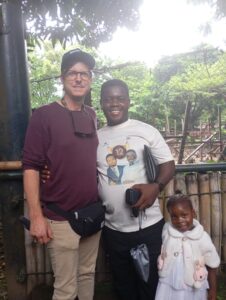
The chimpanzees moved through their enclosure with familiar grace. Mr. Strother watched quietly, standing beside Pastor Atud at the bamboo viewing platform at Limbe Wildlife Center, as the primates swung from ropes and rested in the shade. A child pointed excitedly at the informational sign about primate conservation. A mural of giraffes and antelopes adorned a nearby wall, celebrating Cameroon’s rich biodiversity. This was not a tourist detour. It was a moment of shared wonder, cultural learning, and human connection.
At Joyous Charity Organisation, we believe that effective humanitarian partnerships require a holistic understanding. When international partners like Mr. Strother visit Cameroon during field assessments, we intentionally create space for cultural immersion, visiting historical sites like Bimbia, experiencing conservation facilities like Limbe Wildlife Center, and engaging with Cameroon’s natural heritage. These moments are not distractions from the work. They are essential to it.
This guide explains why cultural and environmental awareness matters in child welfare partnerships, how visiting Limbe Wildlife Center builds authentic relationships, and why understanding a country’s full story its history, its biodiversity, its conservation efforts create more sustainable, respectful humanitarian collaboration.
Visiting conservation facilities like Limbe Wildlife Center during humanitarian field visits helps international partners understand Cameroon’s full context, build authentic relationships with local leaders, and develop deeper respect for the communities they serve. This holistic partnership approach prevents paternalistic aid models and ensures humanitarian work honors cultural heritage, environmental stewardship, and community resilience alongside addressing immediate needs.
Why Cultural Experiences Matter in Humanitarian Work
Beyond the Checklist
We have seen well-meaning organizations reduce field visits to programmatic audits: visit the orphanage, review the budget, inspect the kitchen, sign the papers, depart. This approach treats communities as projects to manage, not partners to walk with.
At JCO, we design field visits differently. During Mr. Strother’s week with SEND ME TEAM USA, the itinerary included:
- Historical grounding at Bimbia’s Port of Slaves
- Conservation education at Limbe Wildlife Center
- Community fellowship with local church partners
- Program assessment at orphanage facilities
- Relationship building through shared experiences of learning and wonder
Why? Because relationships are built in moments, not meetings.
When Pastor Atud and Mr. Strother stood side by side watching chimpanzees at Limbe Wildlife Center, they were not just observing wildlife. They were:
- Sharing silence and reflection
- Experiencing Cameroon’s conservation efforts together
- Building trust through informal conversation
- Recognizing that partnership includes joy, not just hardship
- Acknowledging that this land has beauty alongside its challenges
The Full Story of Place
Cameroon is often reduced in humanitarian narratives to crisis: poverty, displacement, disease, and need. While these realities are real, they are not the whole story.
Cameroon is also:
- Rich biodiversity: From coastal rainforests to northern savannas, home to endangered primates, elephants, and unique ecosystems
- Conservation leadership: Facilities like Limbe Wildlife Center protecting endangered species and educating future generations
- Cultural heritage: Over 250 ethnic groups, diverse languages, traditional practices, and historical resilience
- Natural beauty: Mountains, beaches, wildlife sanctuaries, and community-led environmental stewardship
- Joy and celebration: Music, food, family gatherings, and daily acts of love
When international partners experience this fullness, including visits to places like Limbe Wildlife Center, they are less likely to approach communities with pity and more likely to engage with respect. They see people who steward land, protect heritage, and build beauty amid challenge. This shifts the partnership dynamic from “saving” to “standing with.”
Limbe Wildlife Center: Conservation and Community in Action
What Makes LWC Significant
Limbe Wildlife Center is one of Cameroon’s premier conservation facilities, working to:
- Rescue and rehabilitate endangered primates: Including chimpanzees, gorillas, and other species rescued from illegal wildlife trade, habitat loss, and exploitation
- Educate visitors: Teaching about biodiversity, environmental stewardship, and the connection between human welfare and ecological health
- Provide employment: Creating jobs for local guides, veterinarians, caretakers, and educators from the Limbe community
- Preserve heritage: Maintaining cultural connections to land and wildlife that predate colonial extraction
- Conduct research: Contributing to primate conservation science and best practices in wildlife rehabilitation
When Mr. Strother, Pastor Atud, and a child stood together reading informational signs about primate conservation at LWC, they were participating in intergenerational learning. The child saw adults modeling curiosity. The adults experienced Cameroon’s conservation leadership through the child’s eyes. Everyone learned something about this land’s unique gifts and the dedicated people protecting them.
Connecting Environmental Justice to Child Welfare
We do not separate environmental awareness from child protection. They are connected:
- Climate vulnerability disproportionately affects children in low-income communities
- Deforestation and habitat loss often drive families deeper into poverty and conflict
- Conservation initiatives like LWC create economic opportunities that keep families stable
- Environmental education empowers children to become stewards of their future
When partners understand these connections through visits to facilities like Limbe Wildlife Center, they design programs that are holistic: feeding programs that source from local farmers, education initiatives that include environmental literacy, and economic empowerment that supports sustainable livelihoods.
How Shared Wonder Builds Partnership
The Power of Informal Moments
Some of the most important partnership building happens outside formal meetings:
- Standing together at LWC’s viewing platform, watching chimpanzees
- Walking through the center, asking questions about conservation challenges
- Sharing a meal after the visit
- Laughing together when a child points excitedly at an animal
- Reflecting on what this land has endured and what dedicated Cameroonians are doing to protect it
These moments humanize everyone involved. They remind us that:
- Partners are whole people, not just roles (donor, recipient, staff)
- Joy and learning matter alongside logistics and budgets
- Cameroon is more than its challenges it has beauty worth celebrating and leaders worth honoring
- Relationships require time and shared experience, not just transaction
Modeling Holistic Engagement for Children
When children see international visitors engaging with their country’s heritage and conservation efforts, not just their needs, they receive powerful messages:
- “My culture and environment are worthy of interest and respect.”
- “My country has gifts to offer, not just needs to fill.”
- “Visitors want to know ALL of me, not just my hardship.”
- “Partnership includes celebration, not just crisis.”
This shapes how children view themselves, their heritage, and their future. It prevents internalized shame and builds cultural pride.
Designing Ethical Cultural Experiences
Principles We Follow
Not all “cultural tourism” is ethical. We design experiences that: ✅ Center local leadership: Cameroonian conservationists, guides, and educators lead the learning
✅ Support community economies: Entrance fees to LWC, guide tips, and purchases flow back to local communities
✅ Avoid exploitation: We do not treat poverty or vulnerability as spectacle
✅ Balance seriousness and joy: Historical sites and conservation centers both have a place
✅ Prioritize consent and comfort: No one is required to participate; all voices are honored
✅ Connect to broader context: Cultural visits are framed within partnership learning, not isolated entertainment
What This Looks Like in Practice
During Mr. Strother’s visit to Limbe Wildlife Center:
- Pastor Atud facilitated the experience, sharing his own knowledge and answering questions
- A child was included, modeling intergenerational learning and family-centered engagement
- Entrance fees supported LWC’s conservation work and local employment
- Conversation flowed naturally, building rapport alongside observation
- The experience was integrated into the broader field visit, not treated as a “break” from real work
This is ethical cultural immersion: respectful, reciprocal, and relationship-building.
Frequently Asked Questions (FAQ)
Why include Limbe Wildlife Center visits in humanitarian field assessments?
Conservation and cultural experiences help international partners understand Cameroon’s full context, build authentic relationships with local leaders, and develop deeper respect for the communities they serve. This prevents reductionist “poverty tourism” and ensures partnerships honor heritage, environmental stewardship, and community resilience alongside addressing needs.
Does this take resources away from program work?
No. Cultural immersion is integrated into field visit schedules without displacing program assessment. In fact, it strengthens program design by building trust, contextual understanding, and partner commitment to a long-term relationship.
How do you ensure these visits are ethical and not exploitative?
We center local leadership, ensure fees support community economies and conservation work, avoid treating vulnerability as spectacle, prioritize consent and dignity, and frame all experiences within partnership learning and mutual respect.
Can all field visit participants join cultural experiences?
Yes, with proper orientation. We brief all visitors on cultural protocols, historical context, and ethical engagement. Participation is voluntary, and we ensure experiences are accessible and comfortable for everyone.
How do conservation and child welfare connect?
Environmental health and child welfare are interconnected through climate vulnerability, economic opportunity, food security, and future sustainability. Programs that understand these connections design more holistic, resilient interventions.
What if donors only want to focus on “the work”?
We educate partners that a relationship is the work. Sustainable humanitarian collaboration requires understanding context, building trust, and honoring culture. Partners who engage holistically demonstrate stronger long-term commitment and more effective program outcomes.
How do you measure the impact of cultural immersion?
We track: strengthened partner relationships, increased long-term commitment, more culturally-informed program design, improved community trust, and partner testimonials about how cultural experiences deepened their understanding and commitment.
Conclusion: Partnership Includes Wonder
At Joyous Charity Organisation, we do not measure the success of cultural immersion experiences by how many photos were taken or how many animals were seen. We measure it by the conversation that flowed more freely afterward. By the trust that deepened between local and international partners. By the child who saw their heritage honored, not just their needs assessed. By the partner who left understanding that Cameroon is complex, beautiful, resilient and worthy of partnership, not pity.
Standing together at Limbe Wildlife Center’s viewing platform, watching chimpanzees swing through enclosure ropes, is not separate from humanitarian work. It IS humanitarian work.