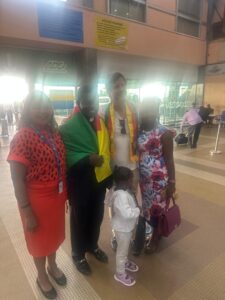
The moment Mr. Strother stepped off the plane at Douala International Airport, we felt it: a shift from distant support to present partnership. Pastor Atud Clovis greeted him warmly. The Cameroonian flag draped gently over his shoulders. Cameras captured the embrace, but the real story unfolded in the quiet moments that followed the listening sessions, the shared meals, the tears shed over children’s stories, and the commitments made not in boardrooms but around simple wooden tables.
At Joyous Charity Organisation, we have learned that international NGO partnerships are not built through wire transfers alone. They are forged through presence. Through the willingness to travel thousands of miles not to inspect, but to listen. Not to dictate, but to learn. When Mr. Strother arrived in Cameroon for a one-week field visit with SEND ME TEAM USA, he did not bring a checklist. He brought curiosity. He brought humility. He brought the understanding that sustainable child welfare begins with hearing the voices of those we serve.
This guide explores how international field visits transform orphanage support in Cameroon, why culturally-grounded partnership matters more than ever, and how your engagement whether as a donor, volunteer, or advocate can help bridge continents for vulnerable children.
International field visits to Cameroon orphanages like Mr. Strother’s week-long journey with SEND ME TEAM USA transform support by enabling direct listening sessions with children, culturally-informed needs assessment, relationship-building with local leadership, and transparent partnership planning. These visits ensure humanitarian aid is guided by on-the-ground reality, not distant assumptions.
Why Field Visits Matter More Than Ever
The Gap Between Intention and Impact
We have received generous donations from supporters who have never set foot in Cameroon. We are deeply grateful. But we have also learned a hard truth: good intentions do not always translate to effective impact when programs are designed without direct community input.
During Mr. Strother’s visit, he sat across from children who shared needs no survey had captured
These were not abstract program gaps. They were human requests. And they reshaped how we prioritize scholarships, health screenings, and emotional support.
Field visits close the distance between donor and beneficiary not just geographically, but relationally. They transform “helping” into “walking with.”
The Cameroon Context: Why Presence Matters
Cameroon is not a monolith. It is a nation of over 250 ethnic groups, multiple languages, complex regional dynamics, and ongoing humanitarian challenges—from displacement in the Anglophone regions to economic pressures in urban centers.
When international partners visit, they gain:
- Cultural fluency: Understanding local customs, communication styles, and decision-making structures
- Operational reality: Seeing firsthand the infrastructure constraints, supply chain challenges, and caregiver dedication
- Trust-building: Meeting Pastor Atud, local church partners, and community leaders face-to-face strengthens collaboration
- Accountability: Witnessing programs in action ensures transparency and builds donor confidence
This is not about “poverty tourism.” It is about informed partnership.
Anatomy of a Transformative Field Visit
Before Arrival: Preparation with Purpose
Effective field visits begin long before the plane lands. For Mr. Strother’s visit, we coordinated closely with SEND ME TEAM USA leadership Jennifer and her husband to ensure:
Clear Objectives:
- Listen to children’s stories and identify priority needs
- Observe daily operations (feeding programs, education support, healthcare access)
- Meet with local partners (Life Transformers Ministries, community leaders)
- Explore cultural grounding (Bimbia Slave Trade Center visit)
Logistical Planning:
- Airport welcome protocol at Douala International Airport
- Accommodation and transportation arrangements
- Translation support for English-French-local language contexts
- Child protection briefings for all visiting participants
Ethical Grounding:
- Consent processes for photography and storytelling
- Trauma-informed engagement guidelines
- Clear boundaries around children’s privacy and dignity
- Commitment to follow-up and action, not just observation
During the Visit: Listening, Learning, Connecting
Mr. Strother’s week unfolded as a model of intentional engagement:
Day 1: Arrival & Welcome
- Warm reception at Douala International Airport with Pastor Atud
- Cultural orientation and safety briefing
- Evening fellowship with local church partners
Day 2: Cultural Grounding at Bimbia
- Visit to the Bimbia Slave Trade Center to contextualize historical trauma and resilience
- Reflection on how historical awareness informs modern child advocacy
- Connection between past injustice and present protection work
Day 3: Faith Partnership in Limbe
- Fellowship at Life Transformers Ministries branch (Mile2, Bahia Junction)
- Meeting with Resident Pastor Atud Clovis and branch leaders
- Discussion on church-NGO collaboration for sustainable child welfare
Days 4–5: Orphanage Immersion & Listening Sessions
- Observation of daily routines: morning check-ins, school preparation, evening meals
- One-on-one listening sessions with children (quiet rooms, trusted caregivers present)
- Participation in Fufu and Eru preparation and community dining
- Documentation of identified needs: scholarships, health support, daily feeding
Day 6: Partnership Planning & Commitment
- Review of observations with JCO leadership
- Collaborative goal-setting for next-phase support
- Prayer and fellowship to ground commitments in shared values
Day 7: Departure & Follow-Up Framework
- Final gratitude expressions and photo documentation (with consent)
- Agreement on communication rhythms and impact reporting
- Personal reflections shared with SEND ME TEAM USA network
After the Visit: Turning Insight into Action
The true test of a field visit is not what happens during the week, but what follows. For us, Mr. Strother’s visit catalyzed:
✅ Program Adjustments: Expanded scholarship tracking, routine health screenings, trauma-informed caregiver training
✅ Donor Communication: Ethical storytelling updates shared with SEND ME TEAM USA supporters
✅ Partnership Deepening: Regular video check-ins, joint fundraising initiatives, shared learning exchanges
✅ Community Reinforcement: Local church partners more engaged in volunteer mobilization and advocacy
Field visits are not endpoints. They are accelerants for sustainable impact.
The Power of Culturally-Grounded Partnership
Beyond “Savior” Narratives
We have seen well-meaning international partners arrive with assumptions: that Western solutions are superior, that efficiency trumps relationship, that metrics matter more than meaning.
Mr. Strother modeled a different approach:
- He listened more than he spoke.
- He asked questions before offering answers.
- He honored local leadership (Pastor Atud’s vision, community cooks’ wisdom, children’s voices).
- He recognized that sustainable change is led locally, supported globally.
This is partnership, not paternalism. And it is the only model that lasts.
Faith as a Bridge, Not a Barrier
SEND ME TEAM USA is a faith-inspired organization. JCO operates with deep spiritual roots. During the visit, prayer was not performative it was connective. Fellowship was not optional it was foundational.
We believe faith-based partnerships, when practiced with humility and respect for diverse beliefs, offer unique strengths:
- Shared values of compassion, dignity, and hope
- Existing community networks through churches and ministries
- Long-term commitment rooted in conviction, not just funding cycles
- Holistic care that addresses spiritual, emotional, and physical needs
But we also honor that not all children or families share the same beliefs. Our approach is inclusive: spiritual support is offered, never imposed.
How International Partners Can Prepare for Meaningful Visits Before You Travel: Essential Groundwork
If you are considering a field visit to Cameroon orphanages, we recommend:
Educate Yourself:
- Learn about Cameroon’s regions, languages, and current humanitarian context
- Understand child protection principles and ethical engagement guidelines
- Research local customs, greeting protocols, and communication styles
Clarify Your Role:
- Are you observing, volunteering, assessing, or all three?
- What skills or resources can you offer during your stay?
- How will you ensure your presence adds value, not burden?
Coordinate with Local Leadership:
- Work with organizations like JCO to align objectives and logistics
- Respect local decision-making structures and timelines
- Budget for fair compensation of local guides, translators, and hosts
Prepare Emotionally:
- Field visits can be deeply moving. Practice self-care and reflection.
- Commit to processing insights responsibly—avoid sharing children’s stories without consent.
- Plan for post-visit integration: how will this experience change your ongoing support?
During Your Stay: Principles for Ethical Engagement
- Listen first, speak second: Center local voices and children’s perspectives.
- Follow child protection protocols: Never photograph children without consent; avoid one-on-one unsupervised time.
- Honor local expertise: Caregivers, cooks, and community leaders know their context best.
- Embrace discomfort: Cultural differences, language barriers, and resource constraints are part of the learning.
- Document responsibly: Take notes for internal learning; share stories publicly only with explicit permission.
After You Return: Sustaining the Connection
- Share insights ethically: Use anonymized themes, not identifiable details, when reporting to your network.
- Follow through on commitments: If you promised to fund a scholarship or upgrade a kitchen, prioritize it.
- Maintain communication: Regular updates build trust more than sporadic grand gestures.
- Advocate thoughtfully: Use your platform to amplify local leadership, not replace it.
Frequently Asked Questions (FAQ)
Why should international partners visit Cameroon orphanages in person?
Field visits build trust, ensure programs align with real community needs, deepen cultural understanding, and create accountability. They transform abstract donations into relational partnerships guided by on-the-ground reality.
How do you ensure children’s safety and privacy during international visits?
We follow strict child protection protocols: all visitors undergo orientation, photography requires explicit consent, one-on-one unsupervised time is avoided, and children’s stories are shared publicly only with anonymization and guardian approval.
What if a visitor does not speak French or local Cameroonian languages?
We provide professional translation support and pair visitors with bilingual staff. We also encourage visitors to learn basic greetings in French or local languages as a sign of respect and relationship-building.
Can short-term visits create dependency or disrupt routines?
When planned intentionally—with clear objectives, local coordination, and child-centered ethics—field visits enhance rather than disrupt. We limit visitor numbers, schedule around children’s routines, and ensure every interaction adds value.
How do you balance faith-based partnership with inclusive care?
We honor the spiritual motivations of faith-inspired partners while ensuring all children receive care regardless of belief. Spiritual support is offered as an option, never a requirement, and we respect diverse religious backgrounds.
What is the typical cost of a one-week field visit to Cameroon?
Costs vary, but partners should budget for: international flights ($1,200–$2,000), in-country transportation and lodging ($500–$1,000), translation and coordination support ($300–$600), and a contribution to host organization logistics ($200–$500). We provide detailed budgets upon request.
How do you measure the impact of international field visits?
We track: program adjustments made based on visit insights, donor retention and increased giving from visiting partners, caregiver feedback on collaboration quality, and long-term partnership milestones (joint projects, sustained funding, shared advocacy).
Conclusion: Partnership Is a Verb
At Joyous Charity Organisation, we do not measure the success of international visits by how many photos were taken or how many handshakes were exchanged. We measure it by the child whose scholarship was funded after a listening session. By the caregiver whose training was upgraded based on observed needs. By the donor who shifted from one-time giving to recurring partnership because they saw the reality behind the reports.
Mr. Strother’s tears during his visit were not a sign of helplessness. They were a sign of connection. They reminded us that humanitarian work is not about fixing broken people. It is about walking with whole people through broken circumstances.
Field visits make that walking possible. They turn distant compassion into present partnership. They ensure that aid is not imposed, but co-created.
We welcome partners who come not to save, but to serve. Not to inspect, but to learn. Not to leave a legacy, but to strengthen a community.